

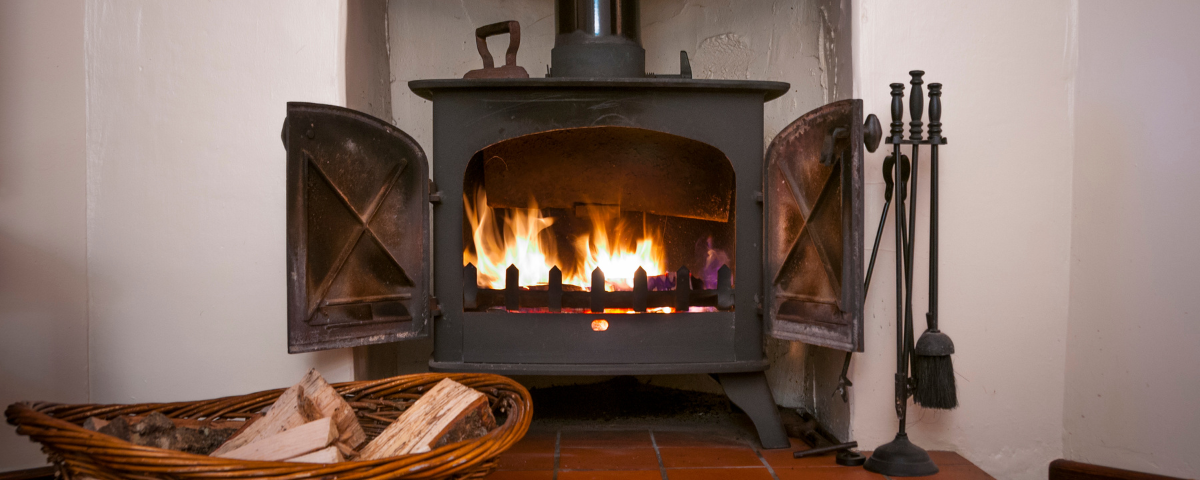
As the European Commission prepares to revise Ecodesign rules for solid fuel heating, a new study reveals that making particle filters mandatory in Europe’s dirtiest home heating method, wood burning, would deliver major public health benefits at a fraction of household incomes.
Sales of wood-burning heating systems are booming across both the EU and the UK. Analysts point to high fossil fuel prices pushing many low-income and rural households back to wood as a heating source.
Despite being the number one source of harmful fine particle pollution (PM2.5) from energy in the EU, most modern wood stoves are still sold without filters. That could soon change as the EU considers an update to its Ecodesign requirements.
A new report commissioned by the European Environmental Bureau (EEB) and conducted by Green Global Future, offers the first EU-level cost-benefit analysis of mandating electrostatic precipitators (particle filters) in all newly sold wood stoves.
Using Denmark and Slovakia as case studies, the results show:
- Filters cut harmful particle emissions by 70%, reducing the health burden of wood stoves by hundreds of euros per year per household.
- Societal health benefits outweigh costs up to 19 to 1, especially in rural areas where wood burning pollution is widespread.
- For most households, filters would cost less than 0.5% of annual income, and even less when offset by savings from switching off gas or oil.
- Even filtered wood stoves still emit 70 times more pollution than heat pumps powered by coal-based electricity.
While industry groups have opposed such requirements over cost concerns, the study finds that the price of inaction is far higher for society.
“In recent years, rising energy prices have driven many households to turn to wood-burning stoves for heating. With the EU carbon price on fossil heating about to kick in, this trend is likely to accelerate, especially in rural areas. But this boom in sales risks worsening air pollution and undermining climate goals. Our analysis shows that one simple, cost-effective solution could prevent this: requiring filters in all newly sold stoves. It’s affordable, feasible, and for vulnerable households, governments can easily step in with targeted subsidies. As EU policymakers revise ecodesign rules, this should be a no-brainer”.
said Davide Sabbadin, Deputy Policy Manager for Climate and Energy at EEB
Read the report.
 English
 Spanish
 Italian
 Czech
 German